


New Funerary Inscriptions from the Roman and Early Byzantine Periods at Obruk Han, a Seljuk Caravanserai
Mehmet ALKAN - İlker IŞIK
Abstract
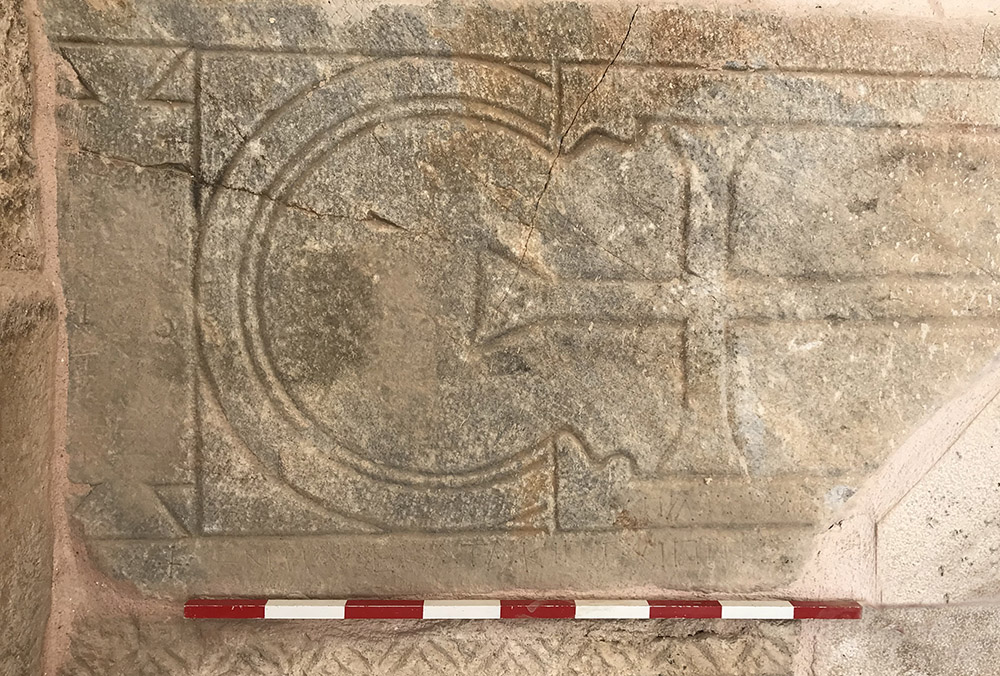
Obruk Han is a Seljuk caravanserai located within the territory of ancient Perta (Giymir), approximately 70 km north-east of Konya (Ikonion) and 1 km south-east of the village of Obruk, in the Karatay district. Located immediately beside a natural sinkhole (Kızören Obruğu), Obruk Han was recently restored and opened to the public. A substantial quantity of ancient building material, including inscribed stones, was reused in the construction of the caravanserai during the Seljuk period. In the mid-20th century, approximately twenty epigraphic finds were discovered in the walls of Obruk Han and in the nearby Muslim cemetery. During the restoration of Obruk Han, thirteen additional inscriptions were uncovered; these are presented in this article.
In the vicinity of Obruk Han, there are no remains of any structures predating the Seljuk caravanserai. Previous researchers have suggested that the ancient materials reused in the caravanserai were transported from Perta (Giymir), an important ancient settlement situated approximately 12 km west of Obruk Han. Most of the inscriptions found at Obruk Han, both previously published and newly discovered, date to the Late Roman and Early Byzantine periods.
Primarily intended to present the newly discovered inscriptions on the walls of the Obruk Han, this article first examines the historical geography of Obruk Han and the provenance and general content of the epigraphic documents found there. Two of the newly discovered inscriptions—one containing the feminine ethnicon of Perta (no. 5: Αὐρηλία Μισσα Περτηνισσα) and the other the word chorion (no. 13: [Γ]άιος Γενν[ά]διος πρεσβύτερος πρῶτος γενόμενος το[ῦ] χωρίου) —suggest that at least some of the inscriptions found at Obruk Han may have been brought there from somewhere outside Perta. Some of the Christian funerary inscriptions contain significant terms and expressions relating to Christian ecclesiastical offices and beliefs in the Lycaonian region, including diakonos (deacon), anagnostes (reader), presbyteros (priest), “the holy catholic and apostolic Church”, and εὐμοίρι, οὐδὶς ἀθάνατος (“Be at peace! No one is immortal”). The formula “the holy catholic and apostolic Church” (no. 13), which also occurs in several Lycaonian inscriptions, indicates that the creeds adopted at the Councils of Nicaea and Constantinople were also accepted in Perta and its surrounding territory. The expression “Be at peace! No one is immortal” (no. 6), which is quite rare in Anatolia and is attested here for the first time in Lycaonia, originated in Syria and the Levant. Its occurrence at Obruk Han may be regarded as evidence of interaction between Lycaonian and Eastern Christians. In addition to the conclusions drawn from the contents of the inscriptions, the article proposes that the site of the Seljuk caravanserai, situated along an ancient route and beside a natural water source, may previously have accommodated a structure that served travellers, such as a lodging facility or a control post.
Alkan, M. ve İ. Işık. 2020. “Doğu Lykaonia’dan Yeni Hristiyanlık Dönemi Yazıtları.” Cedrus 8: 531-545. DOI: 10.13113/CEDRUS.202026.
Ballance, M. H. 1958. “Roman Roads in Lycaonia.” AnatSt 8: 223-234.
Belke, K. ve M. Restle. 1984. Tabula Imperii Byzantini 4: Galatien und Lykaonien (ÖAW Phil.Hist. Kl. Denkschr. 172). Wien: Verlag der Österreichischen Akademie der Wissenschaften.
Breytenbach, C. ve Ch. Zimmermann. 2018. Early Christianity in Lycaonia and Adjacent Areas: From Paul to Amphilochius of Iconium (Ancient Judaism and Early Christianity 101; Early Christianity in Asia Minor 2). Leiden–Boston: Brill.
Dahari, U. ve L. Di Segni. 2009. “More Early Christian Inscribed Tombstones from el-Huweinat in Northern Sinai.” Man Near a Roman Arch: Studies Presented to Prof. Yoram Tsafrir, Eds. L. Di Segni, Y. Hirschfeld, J. Patrich, ve R. Talgam, 125-141. Jerusalem: Israel Exploration Society.
Ertek, T. A. 2009. “Obruk Platosu’nda Devam Eden Obruk Oluşumları.” TÜBİTAK Bilim ve Teknik Dergisi 42(503): 66-71.
French, D. H. 2012. Roman Roads and Milestones of Asia Minor. Vol. 3: Milestones, Fasc. 3.2: Galatia (British Institute at Ankara, Electronic Monograph 2). Ankara: British Institute at Ankara.
ICG = Inscriptiones Christianae Graecae: A Database of Early Christian Inscriptions. Edition Topoi. (http://repository.edition-topoi.org/collection/ICG).
I.Smyrna = Petzl, G. 1982. Die Inschriften von Smyrna, Teil 1 (Inschriften griechischer Städte aus Kleinasien 23). Bonn: Rudolf Habelt.
Kokkinos, N. ve K. D. Politis. 2022. “Two Greek Funerary Inscriptions from Zoara/Ghor As-Safi In Jordan (Early Byzantine Zoora).” Jordan Journal for History and Archaeology 16(1): 99-125. https://doi.org/10.54134/jjha.16.1.5.
LGPN = A Lexicon of Greek Personal Names. Oxford 1987 –
MAMA = Monumenta Asiae Minoris Antiqua, I-XI. London, 1928-2013.
Mitchell, S. 1993. Anatolia. Land, Men and Gods in Asia Minor, Vol. 1: The Celts in Anatolia and the Impact of Roman Rule. Oxford: Clarendon Press.
Németh, G. 2016. “Jesus in Ancient Pagan Magic: The Anna Perenna Drawings.” The Wisdom of Thoth: Magical Texts in Ancient Mediterranean Civilisations, Eds. G. Bąkowska-Czerner, A. Roccati, ve A. Świerzowska, 43-48. Oxford: Archaeopress.
Oberhummer, R. ve H. Zimmerer. 1899. Durch Syrien und Kleinasien. Reiseschilderungen und Studien. Berlin: Dietrich Reimer (Ernst Vohsen).
Robert, L. 1960. Hellenika. Recueil d’épigraphie, de numismatique et d’antiquités grecques, Vol. XI-XII. Paris: Adrien-Maisonneuve.
Robert, L. 1965. Hellenika. Recueil d’épigraphie, de numismatique et d’antiquités grecques, Vol. XIII: D’Aphrodisias à la Lycaonie. Paris: Adrien-Maisonneuve.
Robert, L. 1978. “Documents d’Asie Mineure.” BCH 102: 395-543.
SEG = Supplementum Epigraphicum Graecum, Leiden 1923 –
SGO III = Merkelbach, R. ve Stauber, J. 2001. Steinepigramme aus dem griechischen Osten, vol. 3: Der “Ferne Osten” und das Landesinnere bis zum Tauros. München – Leipzig: K.G. Saur.
Zgusta, L. 1964. Kleinasiatische Personennamen. Prag: Tschechoslowakischen Akademie der Wissenschaften.
Alkan, M. ve İ. Işık. 2026. “Selçuklu Kervansarayı Obruk Hanı’ndan Roma ve Erken Bizans Dönemlerine Ait Yeni Mezar Yazıtları.” Arkhaia Anatolika 9: 76-92. https://doi.org/10.32949/Arkhaia.2026.82